
SIMPLIFIED: "5.2: Phase Transitions"

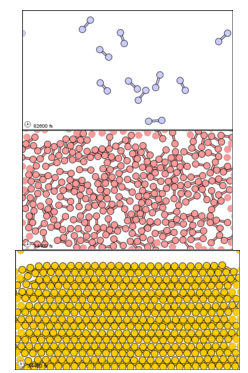
Matter is always changing to different states of matter. Ice melts into water, water boils into steam(gas), and frost can form on a cold window. Even though these are just a few examples, there are many more phase changes that happen. What are they?
When a solid becomes a liquid, the process is called melting. The opposite process, when a liquid becomes a solid, is called solidification or, more commonly, freezing. For example, ice melts into water at 0°C. Melting requires energy because the particles in a solid are tightly packed together, and energy is needed to take the tightly packed particles into more loosely packed positions. The energy needed to melt one mole of a substance is called the enthalpy of fusion.
If more energy is added to a liquid, it can eventually become a gas through vaporization. When particles reach a certain point where they gain enough energy to separate and move freely, it is called the boiling point.
The energy required to turn a liquid into a gas is called the enthalpy of vaporization. Unlike vaporization, condensation releases energy.
Matter is also able to skip the liquid phase completely. This is called sublimation, and it occurs when a solid changes directly into a gas. The reverse process is called deposition.
All of these phase changes are physical changes. The reason is that the substance itself remains the same; only the movement and arrangement of its particles change.

Comments