
SIMPLIFIED: "15.3: Entropy"


Entropy (s) is a measure of how dispersed energy is or how many possible arrangements particles in a system can have. Systems naturally move towards states with higher entropy, which are more probable. Important ideas to remember about entropy are that entropy increases with disorder or energy disorder, and that entropy decreases when a system becomes more ordered. An example of entropy increasing is when ice melts into liquid water, as the particles go from tightly packed to more random orientations. In contrast, when water freezes into ice, the particles go from being more loose to more tightly packed, causing the randomness of the particles to decrease.
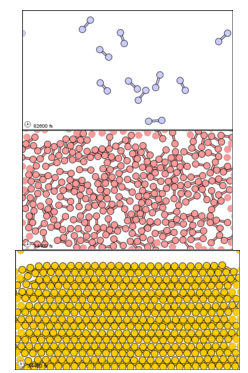
Predicting the sign of entropy is also possible by understanding which state of matter the particles are in. In the solid phase, the atoms are tightly packed together, causing their positions to be restricted in movement. In the liquid phase, the atoms have more space to move around each other while still being in proximity to one another. Because of this, it is possible to predict whether entropy is increasing or decreasing by seeing how the particles are shifting based on the state of matter that they are in.
Factors that increase entropy are an increase in temperature, an increase in gas molecules, an increase in volume, and an increase in particles or complexity of the molecule.
The Second Law of Thermodynamics states that the entropy of the universe increases for every spontaneous process. Even if a system’s entropy may decrease, the surroundings must gain enough entropy so that the total entropy of the universe increases.
Entropy is also understood in terms of Boltzmann’s equation: S = klnW
s= entropy
k = Boltzmann’s constant
W= number of possible microscopic arrangements (microstates)
Natural processes typically favor states with higher entropy because those states have many more possible particle arrangements, which would cause the process to have a higher chance of occurring.
Comments