
SIMPLIFIED: "What's the Difference Between Conduction, Convection, and Radiation?"

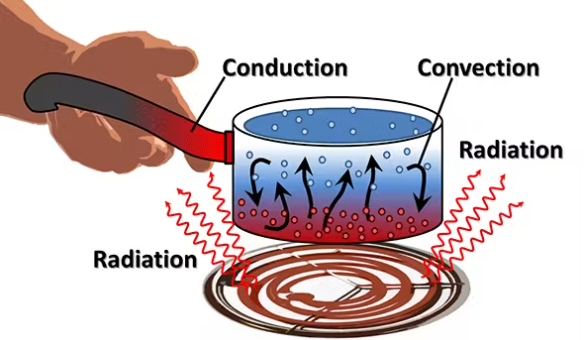
The article linked above talks about conduction, convection, and radiation. Understanding the difference between these three topics is practical for engineering because all three of these concepts deal with heat, specifically heat transfer.
Let’s start with conduction. Conduction is the transfer of heat through physical contact. Here is an example: you are cooking something on a frying pan, you put your hand on the pan, and you immediately jerk it away because it is really hot. That is conduction; heat has transferred from the pan to your hand through physical contact.
Convection is different because it is the transfer of heat through a liquid or a gas, meaning the liquid or gas (a fluid) carries heat as it moves. This means heating through the air, water, or through a medium. Here is an example: if you heat a pot of water, the water at the bottom will rise to the top. The particles are moving to the top while carrying heat with them, hence why it is convection.
Radiation is the transfer of heat through electromagnetic waves. Here is an example of heat transfer through radiation: if you are sitting at a campfire, you will feel warmer when you start a fire because the thermal radiation from the campfire will come towards you, causing you to feel warmer. Another example is the Sun warming Earth. The Sun warms Earth through electromagnetic waves, hence why it is considered radiation.


Comments